


Higher cost and adverse events associated with pharmacotherapy for Alzheimer disease (AD) has led to an increased interest in understanding lifestyle factors, which can help prevent or delay dementia. The 2024 Lancet Commission reported that up to 45% of the dementia cases could be prevented by modifying 14 risk factors across the life course, including midlife physical activity. This highlights the importance of maintaining health and managing risks earlier in life.
Physical activity is a key modifiable factor that can delay or possibly prevent dementia onset. Several studies have demonstrated positive effects of physical activity during midlife or late-life effects on brain structure or connectivity, cognitive function, and risk of dementia. However studies conducted on older adult subjects by recalling their physical activity levels from early life can lead to measurement errors, as elders with cognitive impairment may recall incorrectly. This may lead to reverse causation bias in the research. Hence, studies to determine the effect of physical activity on risk of dementia during different periods of adult life are required.
A recent study published in JAMA Neurology by Marino FR et al., was based on the data from Framingham Heart study and evaluated the associateion between self-reported physical activity in adult life and the risk of dementia. Higher levels of physical activity during midlife and late life were associated with lower risk of all-cause dementia and AD dementia. These findings highlight the need to promote physical activity during midlife or late life to delay or prevent dementia (see the Graphic for the study snapshot).
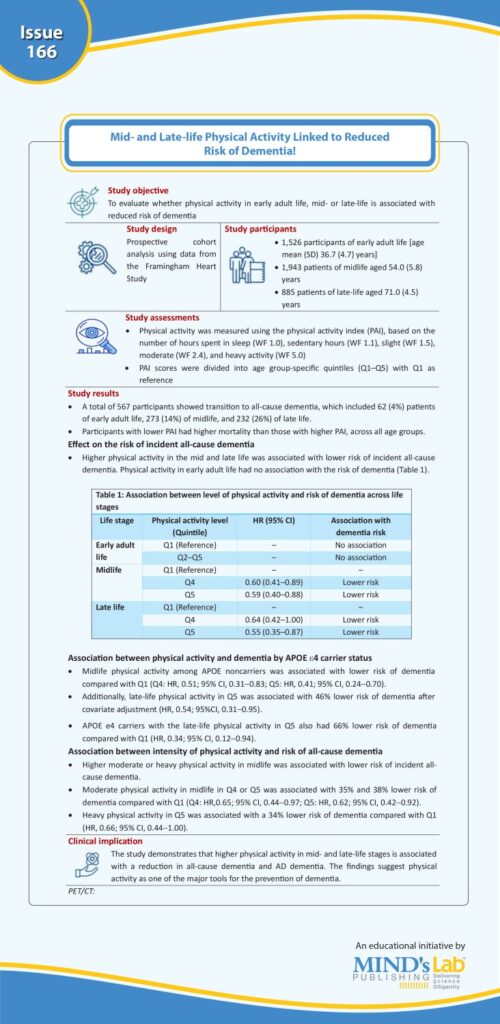
Source: Marino FR, Lyu C, Li Y, Liu T, Au R, Hwang PH. Physical activity over the adult life course and risk of dementia in the Framingham Heart Study. JAMA Netw Open. 2025;8(11):e2544439. Doi: 10.1001/jamanetworkopen.2025.44439.